Deep Learning and Neural Networks: A Beginner-Friendly Explanation
A neural network is a very large function that gets tuned by being wrong repeatedly. What the layers actually do, why depth mattered, and the three things that made it finally work after forty years.

The brain metaphor does more harm than good, so here is the version without it.
A neural network is a very large function. Numbers go in, get multiplied and added and squashed through a few million adjustable parameters, and numbers come out. Training means showing it examples, measuring how wrong the output was, and nudging every parameter slightly in whatever direction would have made it less wrong. Repeat several million times.
That is genuinely the whole mechanism. No reasoning, no understanding, no thinking. A function being fitted to data, at enormous scale, by being wrong repeatedly and adjusting.
Everything impressive that deep learning does falls out of that process running on enough examples.
What The Layers Do
The interesting part is not any individual layer — each does something almost trivially simple. It is what stacking them produces.
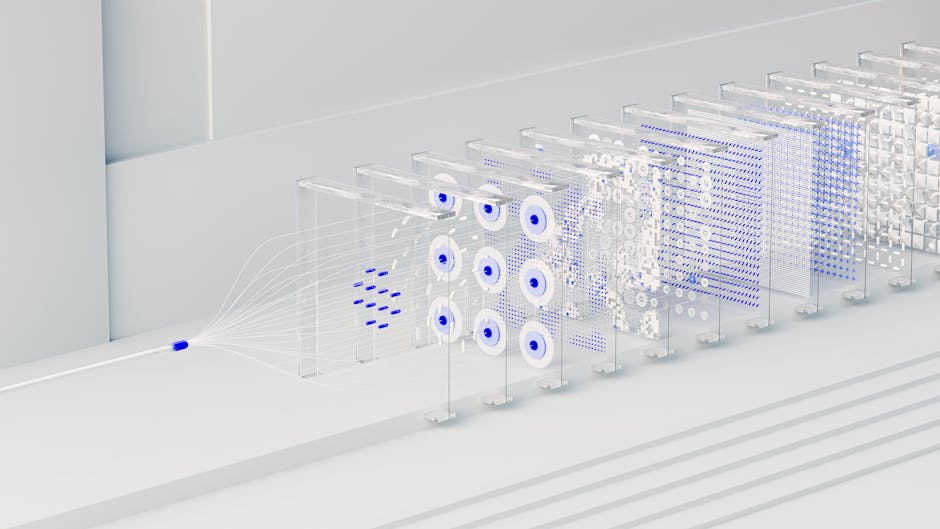
Take image recognition. The first layer, working on raw pixels, learns to detect edges and gradients. Nobody instructs it to; edges are simply the most useful primitive available. The next layer combines edges into corners and textures. The one after assembles those into shapes and parts — a wheel, an eye, a leaf. Later layers combine parts into whole objects.
Each layer builds on the representation beneath it. That compositional stacking is what "deep" refers to, and it is the entire reason depth matters. A shallow network has to map pixels to answers in one leap. A deep one climbs a ladder of increasingly abstract representations, each one a small step from the last.
The same structure appears in language models, working over words rather than pixels — covered in what a large language model is.
How Training Actually Works
Three steps, repeated:
Forward. Push an example through the network and see what comes out.
Measure. Compare the output against the correct answer. The gap is the loss — a single number saying how wrong this was.
Backward. Work out how much each parameter contributed to that error and adjust it slightly in the direction that reduces it. This is backpropagation, and it is the piece that makes the whole thing tractable: it computes, efficiently, the responsibility of every parameter for the mistake.
Run that across millions of examples and the parameters settle into a configuration that produces mostly-correct outputs. Not because anything understood the task, but because that configuration minimises error across the training data.
Which is also the source of every characteristic failure. The network learned what reduces error on the data it saw. Anything systematically different from that data is territory it has no basis for.
The Three Things That Unlocked It
The core ideas are from the 1980s. They sat mostly unused for thirty years, and understanding why is more useful than any architecture diagram.
Data. These methods need enormous quantities of labelled examples. Before large-scale digitisation and the internet, that data did not exist. The field's turning point was as much about a large labelled image dataset becoming available as about any algorithmic advance.
Compute. Training is a vast number of simple parallel operations, which is exactly what graphics hardware was already built to do. Repurposing GPUs took training times from impractical to overnight, and that shift did more for the field than most theoretical work.
Training techniques. Deep networks initially would not train — errors propagating back through many layers would shrink to nothing or explode. A handful of unglamorous fixes to activation functions, initialisation, and normalisation resolved this. Without them the depth that makes deep learning work was unusable.
Worth sitting with, because it recurs: the ideas were not the bottleneck. Data, hardware, and a few practical fixes were.
Where It Beats Simpler Methods, And Where It Does Not
Deep learning wins decisively on unstructured data — images, audio, language, video. Anything where the useful features cannot be written down by a person. That was the wall it broke, and nothing else comes close.
It frequently loses on structured tabular data. Given a spreadsheet of customer accounts and asked to predict churn, gradient-boosted trees routinely match or beat a neural network while training in seconds, running anywhere, and producing a model you can actually inspect and explain to a regulator.
That last point is not a minor convenience. A deep network's knowledge is distributed across millions of weights with no human-readable structure. You can see what it decided. You cannot see why, and in regulated or high-stakes settings that is sometimes disqualifying regardless of accuracy.
The instinct to reach for the most sophisticated technique is usually wrong. The right question is which is the simplest thing that solves the problem — a point covered further in AI vs machine learning vs deep learning.
The Limitations That Do Not Go Away
Data hunger. These systems need far more examples than a person does. A child learns a new animal from one picture; a network may need thousands. Transfer learning — starting from a model trained on something else — mitigates this substantially and does not eliminate it.
Brittleness outside training conditions. Performance can degrade sharply on inputs that differ in ways nobody thought to vary. The failure is rarely graceful and rarely announced.
No calibrated uncertainty. The network outputs a confidence score, and that score is not a reliable indicator of correctness. A model can be confidently, precisely wrong, which is the failure mode underlying most real-world problems — see why AI fails.
Opacity. Interpretability research is genuine and progressing and nowhere near giving you a straight answer to why a specific decision was made.
What To Take From This
If you use AI tools rather than build them, one thing is worth carrying: these systems learned statistical structure in their training data and nothing else.
That single fact predicts almost every behaviour that otherwise seems surprising. Why they are excellent on typical cases and unreliable at the edges. Why they cannot tell you when they are wrong. Why they reproduce biases in their training data. Why they can produce something fluent, well-formed and entirely false.
None of that is a defect awaiting repair. It follows directly from a function being fitted to data — which is what a neural network is, underneath the metaphors.
For the wider picture, how AI actually works covers the mechanics end to end, and computer vision and natural language processing cover what the technique made possible in each domain. If you want to go further hands-on, learning AI from scratch is the sane starting point.
Frequently Asked Questions
- What is deep learning in simple terms?
- A way of building systems that learn patterns directly from data using neural networks with many layers. The deep part just refers to having lots of layers, which is what lets each one build on the representations found by the one before it.
- What is a neural network actually doing?
- Passing numbers through layers of simple operations, each with adjustable weights, and tuning those weights until the output matches the training examples. It is a very large mathematical function being fitted to data, not a simulation of a brain.
- Why is it called deep learning?
- Because of network depth — the number of layers. Early networks had two or three; modern ones have dozens or hundreds. Depth matters because each layer can compose the features found by the previous one, building from edges to shapes to objects.
- Do I need to know maths to understand deep learning?
- Not to understand what it does and where it fails, which is what most people actually need. You need calculus and linear algebra to build and train models from scratch, and almost nobody does that any more — the practical work is applying existing models.
- Why did deep learning only work recently if the ideas are old?
- The core ideas date to the 1980s and lacked three things: enough labelled data, enough compute, and a few training techniques that stopped deep networks failing to learn. All three arrived in the 2010s, which is why decades-old theory suddenly produced working systems.