Deep Learning and Neural Networks: A Beginner-Friendly Explanation
What is deep learning and how do neural networks work? Simple explanation with examples. No math required to understand AI fundamentals.
Deep learning is the technology behind many AI breakthroughs, from voice assistants to self-driving cars. This guide explains how it works in plain language.
What is Deep Learning?
Deep learning is a type of machine learning that uses artificial neural networks with many layers. These networks learn patterns from large amounts of data to make predictions or decisions.
The "deep" in deep learning refers to the many layers in the neural network, not the depth of understanding.
How Neural Networks Work
Inspiration from the Brain
Neural networks are loosely inspired by how the brain works. Just as your brain has neurons that connect to each other, artificial neural networks have nodes that pass information between layers.
But artificial neural networks are mathematical models, not biological simulations.
Basic Structure
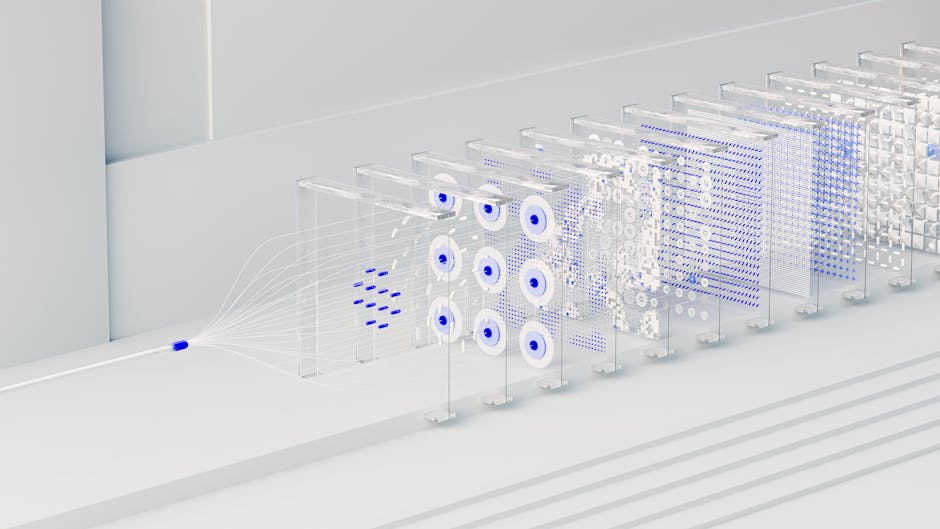
A neural network has three types of layers:
Input Layer Receives the raw data. For an image, this might be the pixel values.
Hidden Layers Process and transform the data. These layers learn patterns and features.
Output Layer Produces the final result, like a classification or prediction.
How Learning Happens
- Forward Pass - Data flows through the network, producing an output
- Calculate Error - Compare output to the correct answer
- Backward Pass - Adjust connection weights to reduce error
- Repeat - Process many examples to improve accuracy
This process is called training. After training, the network can make predictions on new data.
Types of Neural Networks
Feedforward Networks
The simplest type. Data flows in one direction from input to output.
Used for:
- Classification tasks
- Regression problems
- Simple pattern recognition
Convolutional Neural Networks (CNNs)
Specialized for processing grid-like data, especially images.
Key features:
- Convolutional layers detect features
- Pooling layers reduce dimensions
- Preserve spatial relationships
Used for:
- Image classification
- Object detection
- Face recognition
- Medical image analysis
Recurrent Neural Networks (RNNs)
Process sequences of data by maintaining memory of previous inputs.
Key features:
- Loops allow information persistence
- Process variable-length sequences
- Consider context from earlier inputs
Used for:
- Language translation
- Speech recognition
- Time series prediction
- Text generation
Transformers
Modern architecture that processes sequences without recurrence.
Key features:
- Attention mechanism focuses on relevant parts
- Parallel processing capability
- Handles long-range dependencies
Used for:
- Large language models (GPT, Claude)
- Translation
- Text understanding
- Image generation (Vision Transformers)
Key Concepts Explained
Neurons and Weights
Each connection between neurons has a weight - a number that determines how much influence one neuron has on another.
During training, these weights are adjusted to improve predictions.
Activation Functions
Activation functions add non-linearity, allowing networks to learn complex patterns.
Common types:
- ReLU: Simple and effective for many tasks
- Sigmoid: Outputs between 0 and 1
- Softmax: Used for classification probabilities
Loss Functions
Loss functions measure how wrong the predictions are.
Examples:
- Cross-entropy for classification
- Mean squared error for regression
The goal of training is to minimize the loss.
Gradient Descent
The algorithm that adjusts weights to reduce error.
Process:
- Calculate how much each weight contributes to error
- Adjust weights in the direction that reduces error
- Repeat with many examples
Backpropagation
The method for calculating how to adjust each weight, working backward from the output layer.
This efficiently determines how each weight affects the final error.
Why Deep Learning Works
Learning Hierarchical Features
Deep networks learn features at different levels of abstraction.
Image example:
- Early layers: edges and corners
- Middle layers: shapes and textures
- Later layers: object parts
- Final layers: complete objects
Handling Complexity
Shallow networks struggle with complex patterns. Deep networks can represent intricate relationships by combining simpler features.
Data and Compute
Modern deep learning success comes from:
- Massive amounts of training data
- Powerful GPUs for computation
- Better algorithms and architectures
- Transfer learning from pre-trained models
Common Deep Learning Tasks
Image Classification
Assigning labels to images.
Process:
- Input an image as pixels
- Convolutional layers extract features
- Output layer predicts class probabilities
Object Detection
Finding and locating objects within images.
Output includes:
- Object class
- Bounding box location
- Confidence score
Natural Language Processing
Understanding and generating text.
Tasks include:
- Sentiment analysis
- Translation
- Question answering
- Text generation
Speech Recognition
Converting spoken audio to text.
Applications:
- Voice assistants
- Transcription services
- Voice commands
Generative Models
Creating new content.
Examples:
- Image generation (DALL-E, Midjourney)
- Text generation (GPT, Claude)
- Music composition
- Video creation
Challenges and Limitations
Data Requirements
Deep learning typically needs large amounts of labeled data for training.
Solutions:
- Transfer learning from pre-trained models
- Data augmentation
- Synthetic data generation
- Self-supervised learning
Computation Costs
Training large models requires significant computing resources.
Options:
- Cloud computing services
- GPU acceleration
- Model optimization techniques
- Efficient architectures
Black Box Problem
Understanding why a model made a specific decision can be difficult.
Approaches:
- Attention visualization
- Feature importance analysis
- Interpretable model designs
Overfitting
Models may memorize training data instead of learning general patterns.
Prevention:
- More training data
- Regularization techniques
- Dropout layers
- Early stopping
Getting Started with Deep Learning
Prerequisites
Foundational knowledge:
- Basic programming (Python recommended)
- Fundamental math concepts
- Understanding of machine learning basics
Not required to start:
- Advanced mathematics
- Ph.D. level expertise
- Expensive hardware
Popular Frameworks
PyTorch
- Flexible and intuitive
- Popular in research
- Dynamic computation graphs
TensorFlow/Keras
- Production-ready
- Wide deployment options
- Comprehensive ecosystem
Fast.ai
- Beginner-friendly
- High-level API
- Excellent courses
Learning Path
- Learn Python basics if you have not already
- Understand machine learning fundamentals
- Start with simple neural networks
- Progress to specialized architectures
- Work on practical projects
- Study research papers as you advance
Practice Resources
Free courses:
- fast.ai Practical Deep Learning
- Coursera Deep Learning Specialization
- MIT OpenCourseWare
Platforms:
- Google Colab (free GPU)
- Kaggle competitions
- Hugging Face tutorials
The Future of Deep Learning
Current Trends
Foundation models - Large models trained on diverse data, fine-tuned for specific tasks
Multimodal learning - Models that understand multiple types of data (text, images, audio)
Efficient architectures - Smaller models achieving comparable performance
AI agents - Systems that can plan and take actions
Emerging Capabilities
- More natural language understanding
- Better reasoning abilities
- Improved creativity
- Reduced hallucinations
Conclusion
Deep learning has transformed what machines can do, from recognizing faces to generating art. While the mathematics can be complex, the core ideas are accessible.
Start with the fundamentals, practice with tutorials, and gradually take on more complex projects. The field is welcoming to newcomers with many free resources available.
Frequently Asked Questions
What is the difference between AI, machine learning, and deep learning?
AI is the broadest concept - machines that can perform intelligent tasks. Machine learning is a subset of AI where systems learn from data. Deep learning is a subset of machine learning using neural networks with many layers. Deep learning is a specific technique within machine learning, which is itself within the broader field of AI.
Do I need a powerful computer for deep learning?
For learning and small projects, a regular computer works fine. For training large models, you need GPUs. Cloud services like Google Colab offer free GPU access for learning, and cloud platforms provide scalable resources for larger projects.